

 English
 中文简体
中文简体
TURKEY DISTRIBUTOR:
Submit feedback

What Is Release Paper Made Of? Composition, Layers & High-Temperature Uses
On a PVC synthetic leather line, a roll of release paper passes through a coating head at 160°C, transferring a small-litchi texture onto the surface. That paper is not a single sheet of cellulose pulp. It is a precision composite: a resin-saturated base paper with a microscopic release layer. Understanding what release paper is made of starts by separating these functional layers. And the choice of those layers determines how cleanly the paper releases, how well the texture transfers, and how many production cycles it survives.
Over 80% of high-temperature release paper performance is fixed before the paper enters the coating line.
Content
- 1 Release Paper Has Three Functional Layers
- 2 Base Paper and Saturation: The Load-Bearing Core
- 3 Release Coatings: The Thin Layer That Controls Everything
- 4 How High-Temperature Release Paper Handles PVC Casting
- 5 Texture and Gloss: The Product-Level Impact of Composition
- 6 Three Properties That Define Release Paper Performance
- 7 Frequently Asked Questions About Release Paper Composition
Release Paper Has Three Functional Layers
Every release paper, regardless of brand or grade, is built from three functional layers: a base substrate, a saturating resin, and a release coating. The base substrate gives strength and dimensional stability. The saturating resin seals the fibers and controls porosity. The release coating controls peel force and texture transfer. In high-temperature release paper, the saturating resin is thermosetting—usually melamine-formaldehyde or a modified phenolic—so it does not soften when molten PVC is cast at 220°C.
Release paper is a coated substrate that allows a cured material to detach cleanly while preserving an embossed surface pattern.
Base Paper and Saturation: The Load-Bearing Core
The base paper is typically made from wood pulp that has been highly refined. Glassine and kraft are the two dominant types. Glassine is dense, smooth, and grease-resistant because it is supercalendered after pulping. Kraft is stronger but more porous. For synthetic leather release paper, glassine-based stock is common because resin cannot penetrate the sealed surface. Typical basis weight ranges from 80 to 250 g/m², and the industry standard for high-temperature grades is 150 to 220 g/m².
Glassine
Dense and smooth, low porosity, good release surface. Used for translucent release papers and fine textures.
Kraft
High tearing strength, higher porosity, larger surface roughness. Best for peel strength above 25 g/2.5 cm.
The base paper is not passive. Its density and smoothness dictate whether the release coating can transfer a sharp pattern or will soak into the fibers.
Release Coatings: The Thin Layer That Controls Everything
The release coating is usually a silicone or a specialty non-silicone polymer. Silicone coatings offer low release force (below 10 g/2.5 cm) and work well up to 180°C. For PVC leather casting, the coating must withstand temperatures above 200°C and repeated contact with molten paste. Non-silicone coatings—often based on fluoropolymers or crosslinked melamine—give higher heat resistance and a wider range of release forces. The coating weight is tiny, typically 0.5 to 2 g/m², but it controls which finishes are possible.
For a specific example of a matte finish engineered with these coatings, see our gemstone matte grade.
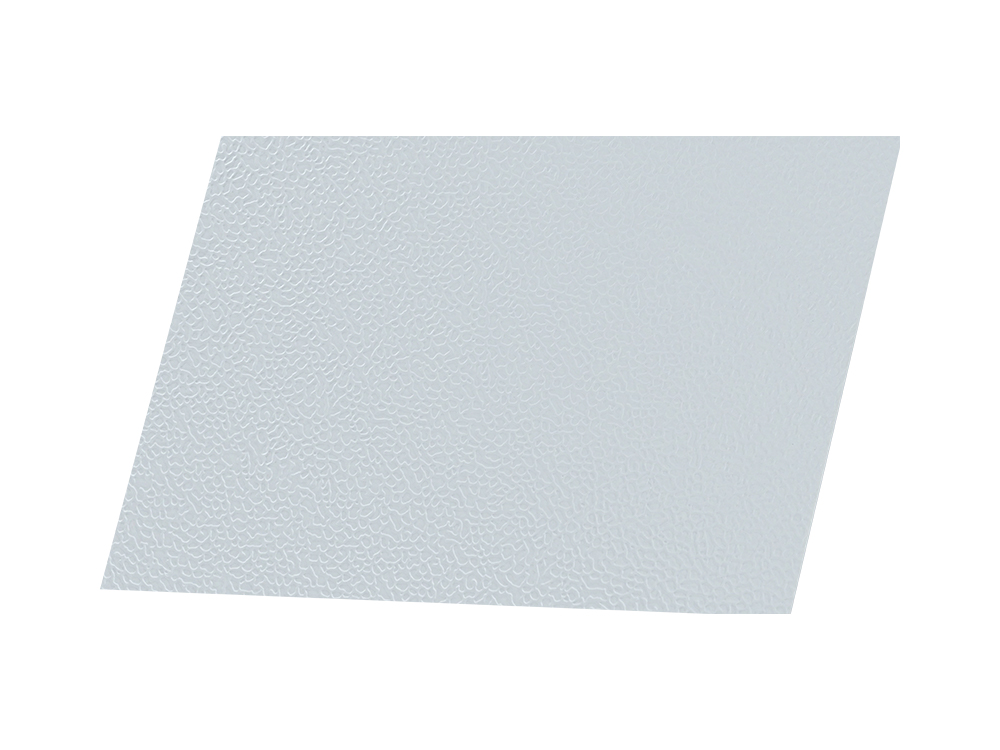 H318 Gemstone Matte High Temperature Release Paper for PVC and Semi-PU LeatherThis release paper is designed for high-end synthetic leather production, delivering a gemstone matte finish while withstanding repeated contact with molten PVC paste above 200°C and offering good reusability.View Product →
How High-Temperature Release Paper Handles PVC Casting
The real test is thermal endurance. During PVC casting, the release paper is pressed against a heated roller, and the PVC paste reaches 200–220°C. The paper must hold its dimensions, keep the coating intact, and still release cleanly after multiple passes. A well-designed high-temperature release paper can survive 10 to 30 production cycles without significant loss of texture transfer.
Maximum Working Temperature of Release Coating Systems
For a small-litchi pattern engineered for repeated high-temperature runs, the H608 grade is a direct example of a super-matt coating that tolerates 220°C process peaks.
 H608 Small Litchi Pattern Super Matt High Temperature Release PaperFeaturing a delicate small litchi texture and super-matt gloss, this grade tolerates processing peaks up to 220°C. It suits automotive interiors and other high-end synthetic leathers requiring precise texture and low gloss.View Product →
Texture and Gloss: The Product-Level Impact of Composition
Texture is embossed into the release surface during coating. Gloss is controlled by the base paper roughness and the coating's surface energy. Honghuan's H-series demonstrates how composition scales across finishes: each texture family contains four gloss levels—super matt, matt, semi-matt, and semi-bright. A super-matt surface requires a high-viscosity coating and a textured base paper, while a semi-bright surface uses a smoother base and a lower-profile coating.
| Gloss level | Base paper | Coating type | Typical applications |
|---|---|---|---|
| Super matt | Heavy glassine | High-viscosity resin | Car interior, anti-glare |
| Matt | Standard glassine | Blended silicone | Sofa, luggage |
| Semi-matt | Kraft-glassine mix | Crosslinked melamine | Footwear, bags |
| Semi-bright | Smooth kraft | Low-viscosity silicone | Flooring, decorative |
The plain matte grade, H818, is a common starting point for evaluating release paper construction because it exposes the interaction between base paper density and coating holdout.
 H818 Plain Matte High Temperature Release Paper for Synthetic LeatherA plain matte release paper engineered for semi-PU and PVC leather production, providing stable release, durable flatness, and multiple reuse cycles. It suits automotive, flooring, sofa, and luggage leather applications.View Product →
Three Properties That Define Release Paper Performance
When buyers evaluate release paper for synthetic leather, they measure three things: release force, texture transfer fidelity, and thermal resistance. Release force is the peel strength required to separate the cured film. Texture transfer is the accuracy of the embossed pattern. Thermal resistance is how many cycles the paper can sustain without delamination.
- Release force: 5–60 g/2.5 cm depending on gloss and resin system.
- Texture transfer: defined by the base paper smoothness and the coating’s surface energy.
- Thermal resistance: above 200°C for PVC casting, with cycle counts of 10–30.
220°C is the typical peak temperature in continuous PVC leather casting lines.
For a step-by-step comparison of these properties across grades, see our leather release paper selection guide.
Frequently Asked Questions About Release Paper Composition
Is release paper the same as parchment paper?
No. Parchment paper is a single-layer silicone-coated paper for baking. Release paper for synthetic leather is a resin-saturated composite with a functional release coating that survives high temperatures and repeated use.
Can release paper be reused?
Yes. High-temperature release paper can be reused multiple times, typically 10–30 cycles, depending on the coating and the process conditions. Each cycle changes the release force slightly.
What coating gives a super-matt finish?
A super-matt finish comes from a highly viscous or textured coating that scatters light. In the H-series, it is produced with a heavy glassine base and a specially thickened release layer.
How do I choose between silicone and non-silicone release?
Use silicone for cold and low-temperature processes. For PVC and PU casting above 180°C, choose a non-silicone or high-temperature crosslinked silicone system, because standard silicone degrades and leaves residues.

Feel free to contact us now!
We provide customers with sustainable and environmentally friendly release paper products and services.


-

-
 INDIA DISTRIBUTOR:
 -
 ITALY DISTRIBUTOR:
 -
 PAKISTAN DISTRIBUTOR:
Copyright © Anhui Honghuan New Material Technology Co., Ltd. Rights Reserved.
Custom Casting Release Paper Factory